

Never shall man take me hence
But only he by whose side
I ought to hang and he shall
Be the best knight in the world.
Taken from the castle feast
To an abbey in the East
Three knights stood in pride as one
Lancelot beheld his son.
Arthur's court he bade him come
Galahad his bastard son
Battles soon for him to fight
Blessed his youthful son a knight.
Arthur and the knights marvelous stone
Floating upon the river alone
Pointing from the rock, the sword shining bright
Glittering jewels, shimmering light.
Pull me, pull me, pull me, pull me.
Gawain first he tried to draw from the stone
To wear by his side
Each knight took his turn
Brave to the last
Faced with the sword remaining fast.
Arthur called a knight young Galahad
Saw in his sheath no sword he had
Took him where the sword
Held by the stone
Offered him there to make it his own.
Pull me, pull me, pull me, pull me.
He fell on his knees
To pull out the hilt
And drew it with ease
The dolorous stroke it was struck with pride
The sword it was hung by Sir Gawain's side
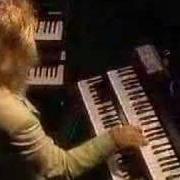
Richard Christopher Wakeman, meglio conosciuto come Rick Wakeman, è un tastierista e compositore britannico nato nel 1949. Considerato uno dei pilastri del progressive rock degli anni '70, ha raggiunto fama internazionale per la sua tecnica virtuosistica al pianoforte e organo, oltre che per le sue composizioni elaborate e sinfoniche. Wakeman è noto soprattutto per il suo periodo con gli Yes (1972-1974), durante il quale ha contribuito a definire il sound della band con album iconici come "Fragile", "Close to the Edge" e "Going for the One". Dopo la sua uscita dagli Yes, Wakeman ha intrapreso una brillante carriera da solista, pubblicando numerosi album di successo che spaziano dal progressive rock al neoclassico. Tra i suoi brani più famosi figurano "Catherine Howard", "Journey to the Centre of the Earth" e "The Black Knight". Wakeman è anche un compositore prolifico per film, teatro e balletto, dimostrando una versatilità artistica che lo ha consacrato come uno dei musicisti britannici più influenti del XX secolo.